
Category: Chelsea Wolfe

  • When Chelsea Wolfe is giving it all that she’s got, as on big, string-laden anthems like “House of…

    When Chelsea Wolfe is giving it all that she’s got, as on big, string-laden anthems like “House of Metal” and “The Waves Have Come,” it’s like her voice also contains something of a whisper within it, a tinge of breathy spaciousness that feels somehow kinesthetically continuous with the wide open, natural vistas that she’s singing about. Her voice is less the human focal point of her new album, Pain Is Beauty, though, than the LP’s instrumental center, the defining atmospheric element in a churning pool of moods and melodies that seems to always be on the verge of drowning in its own romantic oblivion—until it suddenly throws you for a new turn, that is. I spoke to Wolfe about her departure from the acoustic arrangements of her last full-length effort, Unknown Rooms, and why pain can be beautiful sometimes. The album is out now via Sargent House.

    You’re returning to a more electronic palette this time around. What led to that decision? They’re actually songs that [synth and bass player] Ben [Chisholm]and I have been working on for 2 or 3 years now. We started doing electronic songs in the mindset that we would do a side project with them, and we didn’t really have time to do that. We just started playing them live in the Chelsea Wolfe project and decided that we wanted them to be Chelsea Wolfe songs, and we sort of re-approached them and added new life to them. And it’s really fun playing the electronic songs live as well, so that was part of the motivation.

    What’s fun about it? It’s just a totally different energy. I’m so used to guitar-driven music. It still has guitar and drums driving it; it’s still a full band feel in my opinion. But having my hands free a lot and just being able to focus on singing and using my voice as an instrument is really new and interesting for me.

    What aspects of vocal technique do you think about now that you didn’t think necessarily think about before? I don’t know. I think it’s just taking a song and kind of naturally going with what voice comes to me, like whether it’s something that’s more whispery and intimate or something that’s really loud and me singing with all my strength. I think there’s a few different kinds of voices on this album, and it’s kind of me exploring what my voice can do and what each song needs. I definitely like to try new things and experiment with new sounds, and I have always thought of the human voice as an instrument; that’s why I like to sing through pedals a lot.

    What would you say that you took away from making the acoustic album? I suppose it was an exercise in keeping things minimal. I really love recording, so I love adding tons of harmonies and layers. The acoustic album was definitely my more folky, minimal songs, and it was an exercise in holding back and trying to keep them where they need to be and not making every song feel really epic. It was a lesson in simplicity.

    How’d you come up with the album title, Pain Is Beauty? A lot of the songs on the album are about the intensity of nature: the way that nature affects humanity and the way that humanity affects nature. There’s this sense that there’s so many things we have to overcome, and so many processes that have to go through. It almost could have been titled “Pain Becomes Beauty,” because when you think about forest fires and things like that, it seems like such a terrible thing and it’s so harsh, but it really makes new room for growth to happen. It can be the same in our own lives—there’s always gonna be situations that we go through that are really hard and we just have to kind of be strong, and if we get through to the other side, then we become wiser people and our lives become more beautiful. There’s definitely a beauty on the other side of that transformation.

    Are you someone who spends a lot of time in nature personally? I try to. It’s hard, living in LA and being really busy. I’m from Northern California. I really love it up there. I spent a lot of time when I was a kid in the giant redwoods and going to the river and the ocean and things like that, so I definitely try as many chances as I get to go back up to Northern California and free my mind—quiet my mind a little bit.

    The press release for the album also mentions an exploration of ancestry. Is that referring to something in the deep past or something in the more recent, American past? I think a lot of it for me was this idea that maybe there’s so many unhappy people in America because we’re living on a land that is basically stolen from people who already lived here. There’s this sort of unrest that maybe still lives in the ground or the air; it’s kind of about energies. Also, most everyone that lives here comes from somewhere else. My own personal family is mostly Norwegian and Germanic. It’s kind of interesting to think about the mythology of our ancestors and wondering if it still kind of lingers in us somewhere—something that exists through the bloodline of a family. There’s one song that’s more specifically about it: the one that’s called “Ancestors, the Ancients.” It’s just something that’s been on my mind.

    You’ve said that the songs on this album are some of the most honest songs you’ve written. What sort of soul-searching, beyond this ancestry idea, went into the making of this album? I don’t know if I think about it as “soul-searching,” but I think often times I write about things that are outside of myself. I write stories about other people’s lives, and I try and think about things from other people’s perspectives, but on this one I think there’s more songs that are more from my perspective, more from experience. There’s an honesty to this album that comes from somewhere inside of me that I wasn’t ready to expose in the past. I guess I just didn’t want to write a bunch of break-up albums, where I was talking about my personal life and things like that. I still don’t talk about my personal life very much. Even photo-wise, for the cover, I definitely covered myself up in different ways. This is the first album where you can fully see me, and I tried to be brave in that respect.

    How do you usually write the lyrics? Do you come up with melodies first? It usually happens at the same time. I guess I’m always writing things down if I have some sort of idea in mind. A lot of times, it starts with a concept or a subject that I’m interested in—like I said, ancestry or the intensity of nature. One of the songs on the album is very directly inspired by the earthquake and tsunami that happened in Japan that there was so much footage of on TV; it was just so insane to watch that happen. And then I watched a documentary and a lot of it was first-hand footage; as soon as I watch something like that, it really just sticks in my head, and I ended up sitting down and writing a couple songs about that. I usually just write when information comes, and a lot of times the whole song comes at once, melody and words and everything. It’s not a conceptual album. There’s a lot of different things it’s about: it’s about ancestry, it’s about nature, it’s about tormented love and sort of overcoming the odds. There’s a lot of different themes on this album.

    I want to hear more about the tormented love aspect. I think often sometimes people forget how much hardship can go into love and making love and a relationship work. I think it’s presented to us from the time we’re children as something that should be so easy and perfect and beautiful, but it actually takes a lot of patience and a lot of sweat and tears. So I guess I was trying to think of things from a more realistic side. Beyond that, it can be confusing, and you fall in and out of love, so there’s torment there.

    Do you think it’s in expressing that torment that you can overcome it in some way? I suppose so. One of the songs was loosely inspired by the end of the book 1984. I read that book a long time ago, and I always hated that he gave his true love up— he named her or whatever. He was being tortured, and he was like, No, torture her. Put her in my place. I always hated that, and I wrote my own ending to it. There’s an idealism in me that you should be strong enough to fight for the one that you love and take pain for the one that you love. That’s my way of being romantic, I suppose. How love is so—just the way it’s presented in the media. It’s so gross these days. I don’t know if I want to get into it because I don’t like to comment on other people’s work or lives. But I think generally people might know what I mean when I say that.

    Generally speaking, is there anything you want people to take away from this album? A few people who have heard it have commented that it feels very healing to listen to, and that was one of the highest compliments that I could receive, really. If someone can take that away from listening to the album—like a sense of healing and the sense that you’ve been able to overcome something—that’s really special to me.

    Did you feel healing in making it? Yeah, I definitely think there was a process of healing for myself as well— just learning about the process of overcoming, as I’m writing about it. A lot of times I’ll write about things that I want to learn more about.

  • Rhapsody Presents: Chelsea Wolfe “We Hit A Wall” live from Sonos Studio

    Chelsea Wolfe performs a special rendition of “We Hit a Wall” from her new album Pain Is Beauty that is out today, September 3, 2013 on Sargent House. Video shot live from Sonos Studio courtesy of Rhapsody Music.

    Get Chelsea Wolfe’s Pain Is Beauty on VINYL or CD HERE
    or on Itunes

    CHELSEA WOLFE IS ON TOUR NOW SEE ALL DATES HERE

  • CHELSEA WOLFE“Pain Is Beauty”(Sargent House) A shudder of emotional torment, poised between a swoon…

    CHELSEA WOLFE
    “Pain Is Beauty”
    (Sargent House)

    A shudder of emotional torment, poised between a swoon and a sob, resides in the voice of Chelsea Wolfe, and the ambiguity feels custom fitted to the music. “Pain Is Beauty,” her fourth album in three years, confirms her steadiness as a singer-songwriter of gothic intention, drawn to romantic fatalism and beautiful ruin.

    Ms. Wolfe, who originally hails from Sacramento, has made her name in Los Angeles, and there’s a sly connotation of noir in her whole enterprise. Her first two albums — “The Grime and the Glow” and “Apokalypsis,” on Pendu sound – put her forth as a sepulchral wraith. Her third, “Unknown Rooms: A Collection of Acoustic Songs” (Sargent House), exuded a spare and chilling composure, more intimate but hardly less opaque.

    She produced “Pain Is Beauty” with Ben Chisholm, who plays bass and synthesizer on the album, alongside the guitarist Kevin Dockter and the drummer Dylan Fujioka. (The same personnel are currently on a tour that reaches the Bowery Ballroom on Sept. 13.) There’s a slight push toward synthetic texture, though the prevailing sound still involves her voice against a twangy guitar, both bathed in cavernous reverb. Mainly the electronics furnish details like the rhythmic thrum in “Feral Love,” which calls to mind the fleet of helicopters in the opening scene of “Short Cuts,” the Robert Altman film.

    You don’t have to reach to find other cinematic elements on the album, from the horror-movie organ drone of “Kings” to the washed-out retro-pop of “Destruction Makes the World Burn Brighter,” offered in tribute to David Lynch. Elsewhere the allusions feel more rooted in the realm of music, as when “House of Metal” coalesces around a dolorous, slow-to-unfold arpeggio, evoking Portishead.

    Ms. Wolfe has often said that she draws inspiration from Scandinavian black metal, but it’s a fair question whether that claim has more to do with an image, or an idea, than it does with actual sound. On a few of these new songs, like “We Hit a Wall,” her singing is actually most reminiscent of Feist.

    In any case, the attractive but suffocating atmosphere on “Pain Is Beauty” should be understood as precise aesthetic calculation. On “The Waves Have Come,” Ms. Wolfe sings slowly and heartbreakingly from the vantage of a tsunami survivor. On “Sick,” she basks in the toxic runoff of a relationship. And a doom-folkish tune called “They’ll Clap When You’re Gone” includes the line “I carry a heaviness like a mountain” — a stoical complaint that sounds as if it’s sung inside a grain silo, in abject and perfect solitude. NATE CHINEN

  • LA WEEKLY Cover Story on Chelsea Wolfe out now

    image

    image

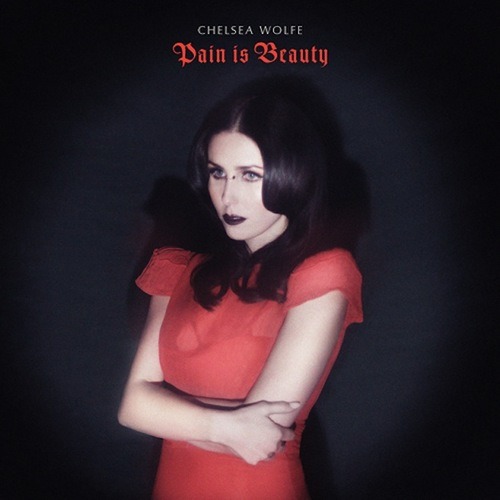
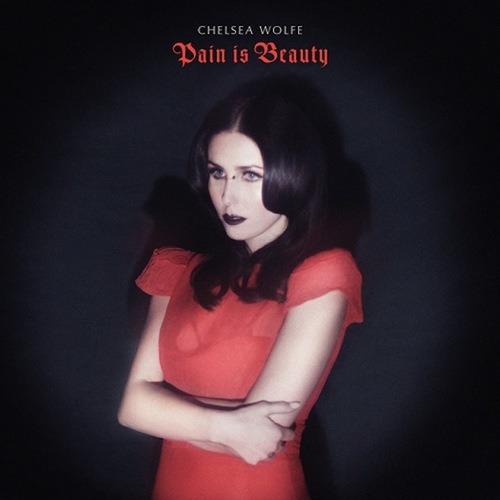
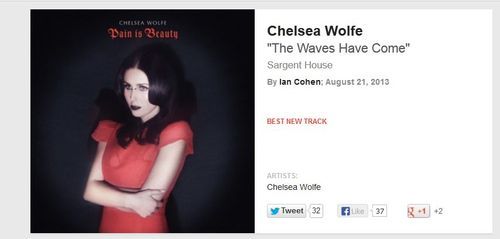
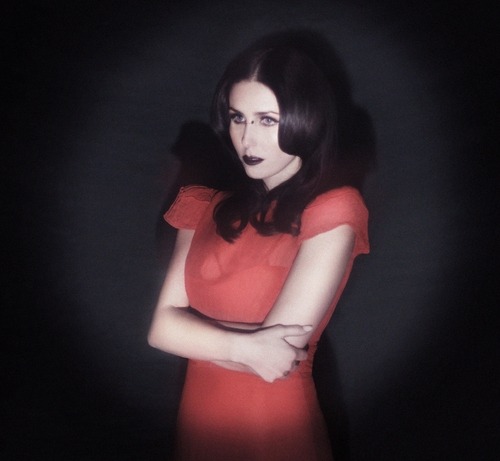
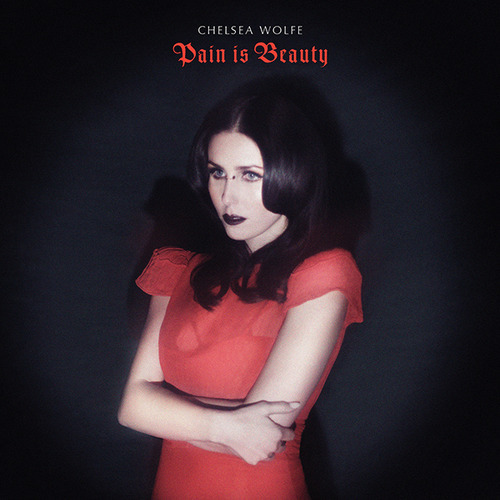
    Chelsea Wolfe is looking at a picture of herself. It’s on the cover of the deluxe vinyl version of her new album, which is out this week. She’s seeing it now for the first time, sitting at the dining room table at the Echo Park home of her record label, Sargent House. The photo shows her standing in a bright spotlight against a black background, attired in a scorching red vintage dress. She wears dark lipstick and holds a piercing gaze through black-lined eyes, yet her shoulders are slightly hunched, her pale arms clasped tightly to her midriff as she clutches her elbows with the opposite hands. It’s the body language of a strange, tall girl at a middle-school dance, just after her growth spurt. “There I am in the spotlight,” she says between drags of a cigarette, “looking a little uncomfortable.”
    image

    photo by Kristin Cofer

    The shot is well chosen, least of all because it’s gorgeous; it also perfectly encapsulates this moment in Wolfe’s career. It depicts the downtown dweller emerging from her shadowy goth-folk stage and forging her status as a sophisticated figure with a crystallized point of view, succinctly spelled out in the album’s title, which floats in crimson, doom-metal typeface above her black-maned head: Pain Is Beauty.

    Since the release of her 2010 debut album, The Grime and the Glow, Wolfe, has attracted a small army of fans in the United States and Europe — including a random smattering of celebrities such as John Cusack, Dave Navarro and Sasha Grey — with some of the most dramatically gloomy music coming out of Los Angeles right now. Her canon is all emotion, with cryptic lyrics full of yearning, focused on death and devastation, set against haunted, heavily reverbed sound scapes that range from guitar strums and electronic samples to found sounds and disturbed screeching.
    image
    this photo and LA Weekly cover image by Ryan Orange

    Her second album, last year’s Apokalypsis, begins with the unnerving track “Primal/Carnal,” which could easily be used on loop as sound effects for an arty haunted house. But Wolfe always includes a dab of hope in all that unholiness, for contrast. “Life is always bringing shit our way,” she explains. “When we deal with it, we come out wiser and stronger and have a more beautiful outlook. Pain becomes beauty.”

    The new album seals her vision with tales of tormented love set against impossible conditions, including titles like “Destruction Makes the World Burn Brighter” and “The Waves Have Come,” a selection based on a man widowed by the 2011 tsunami.

    Wolfe points out that the red dress she wears on the album’s cover represents volcanic lava. “I was thinking about how nature can just, like … ” she trails off for a second, overwhelmed by her own thoughts, then refocuses her ice-blue eyes. “We think we have everything under control, but we really don’t,” she says. “There could be an earthquake right now.”

    Despite the darkness in her music, Wolfe is kind, almost light, in person. She speaks warmly about the things that matter most to her — art, nature, love — but remains cagey about personal details, and her lyrics offer few concrete clues about her own life story.

    “I think a lot of the album, thematically, is about idealistic love,” she says. “The Warden,” for example, is an alternate ending to 1984, where the imprisoned protagonist refuses to give in to torture, agonizing until his last breath to protect his lover.

    On “Sick,” Wolfe reveals the benefit of languishing inside a difficult relationship. “This suffering brings me closer to you/and time is broken and moves slow,” she sings.

    With every ghostly wail, she exposes an unwavering truth — love is hard. “When you’re really in love with someone, it’s not always easy,” she says, careful not to wreck her mystery with any real specifics. “It’s so beautiful and it’s so fucked up.”

    She’s always been this intense. As a little girl, Wolfe sought tragedy obsessively. “My parents thought there was something wrong with me because I would watch the world news for hours and cry about all the shit people were going through,” she recalls earlier, over drinks at downtown trip-hop haunt Pattern Bar. “I just wanted to feel it all and understand the world beyond my own little realm.”

    Growing up in Sacramento, Wolfe began writing sad songs in her country-musician father’s studio around age 9, but up into adulthood she stayed away from the stage. After dabbling in various university studies and career starts, by the late 2000s she’d let her friends convince her to focus on music.

    Originally a painfully self-conscious performer who often appeared onstage with a black veil over her face, Wolfe eventually overcame her fears, embracing ethereal fashion and emphasizing her own natural height (she’s 5 feet 9 inches) with teetering heels. “I decided if I’m going to take this seriously,” she says, “I should dress up for work and give it my all.”

    Last year, she became even more vulnerable to her listeners with her acoustic collection, Unknown Rooms. Previously scattered across the Internet, the album of stripped-down “orphan” recordings was her first release on Sargent House, the local label owned by entertainment entrepreneur Cathy Pellow.

    “She was always lumped in with these droney-ass bands,” Pellow says of Wolfe’s branding, citing the cover of Apokalypsis, which features a medieval-style photo of Wolfe with her eyeballs whited out. “I wanted to open the doors to people who would have written her off as creepy and scary, so they could hear the purity and uniqueness of her voice.”

    The pastoral love song “Flatlands,” with its spare guitar and gentle string arrangement, made its way around the Internet via a video collaboration with Converse and Decibel magazine, setting the scene for the more electronic-oriented Pain Is Beauty. By the time the new album’s single, “The Warden,” hit Soundcloud in June, its industrial-clubby beat seemed like a natural expansion on Wolfe’s varied sonic palette.

    “I think about the lifespan of an artist,” says Pellow, who represented film talent in New York City before moving to L.A. in the mid-2000s to build Sargent House around her personal passion for progressive rock bands like Russian Circles, Deafheaven  and Hella. “It was, like, let’s let a lot of people who don’t listen to heavy music find out Chelsea’s not that heavy. This way, down the road, she can do whatever she wants.”

    Sargent House sits at the edge of Elysian Park. The historic, Spanish-style mansion houses the label’s offices, a small studio and a window-encased alcove used primarily as the performance space for “Glass Room Sessions,” the series of live acoustic performance videos in which Wolfe was featured last year.

    Pellow encourages a party like atmosphere around creative and business collaboration. Tonight, the gathering includes in-house producer Chris Common, new signee Emma Ruth Rundle, Wolfe and her bandmate and co-producer Ben Chisholm. Wolfe and Chisholm chat about their recent video shoot with director Mark Pellington (who shot the iconic video for Pearl Jam‘s “Jeremy,” among many others), before Wolfe ducks into the studio to sing on Rundle’s upcoming album.

    Wolfe at various times calls herself “shy,” “not outgoing” and “a bit of a loner.” She’ll claim she isn’t an L.A. artist, she isn’t an anything artist, and she’s never felt the need to fit into any scene. Here, at least, she seems at home, which might make it a bit easier to step into the limelight and face unknown heights of success and scrutiny.

    “Life is really hard,” she says. “You have to persevere.”

    It’s not clear if she’s talking about herself or the entire history of humanity. Maybe it’s both.

    By Christina Black

  • $5 Album Sale: Chelsea Wolfe & Russian Circles tour Europe together and both release new albums

    image

    To celebrate the upcoming European tour together and the new albums coming from both  Chelsea Wolfe and Russian CirclesSargent House has made both bands last albums only $5 each in any file size you like all this weekend starting today – Thursday, August 22nd – Sunday, August 25th.

    image
    Pre-Order the NEW album “Pain Is Beauty” by Chelsea Wolfe HERE
    Release date: September 3, 2013
    SEE ALL CHELSEA WOLFE TOUR DATES HERE

  • Click above to go to Story

    imageimageimage
    Click above to go to Story

  • Where the sparse arrangements of her 2012 acoustic album, Unknown Rooms, spotlighted the…

    imageimage

    image

    Where the sparse arrangements of her 2012 acoustic album, Unknown Rooms, spotlighted the incremental fluctuations of her voice, Chelsea Wolfe‘s Pain Is Beauty feels like a more wide-angled affair, folding her soprano into swaths of strings and pulsating synths until the result feels as a vast and intimidating as the wild expanses of land and water she’s singing about. Wolfe has called the album her “love-letter to nature,” and while the switch to a more electronic palette would seem to contradict this mission statement, the repetitive, melodically cyclical chorus on “The Waves Have Come” grows with the awe-inspiring momentum of a real-life tornado. Fittingly, there’s a trace of the literary notion of the sublime (or the co-existence of of terror and ecstasy) in the scenario she describes in the song: When earth cracks open and swallows then we’ll never be tired again, and we’ll be given everything the moment we realize we’re not in control. Pain is Beauty Out September 3 via Sargent House.

    SEE ALL CHELSEA WOLFE SHOW DETAILS HERE

    CHELSEA WOLFE
    8/25 – Los Angeles, CA @ FYF Fest, LA History Park
    9/01 – Tucson, AZ @ HOCO Festival at Hotel Congress


    CHELSEA WOLFE & TRUE WIDOW
    9/03 – Phoenix, AZ @ The Crescent Ballroom
    9/04 – Albuquerque, NM @ Launchpad
    9/06 – Austin, TX @ Mohawk
    9/07 – Houston, TX @ Fitzgerald’s
    9/08 – New Orleans, LA @ One Eyed Jacks
    9/09 – Atlanta, GA @ The Earl
    9/10 – Chapel Hill @ Local 506
    9/11 – Washington DC @ Rock and Roll Hotel
    9/13 – NYC, New York @ Bowery Ballroom
    9/14 – Philadelphia, PA @ Union Transfer
    9/15 – Cambridge, MA @ The Sinclair
    9/17 – Toronto, ONT @ Horseshoe Tavern (NO True Widow)
    9/19 – Pontiac, MI @ The Pike Room at Crofoot Ballroom
    9/20 – Lexington, KY @ Boomslang Festival
    9/21 – Chicago, IL – The Bottom Lounge
    9/22 – Minneapolis, MN @ Cedar Cultural Center
    9/24 – Denver, CO – Larimer Lounge
    9/25 – Salt Lake City, UT @ Urban Lounge
    9/26 – Boise, ID @ The Shredder
    9/27 – Seattle, WA @ Barboza
    9/28 – Portland, OR – Doug Fir Lounge
    9/30 – San Francisco, CA @ Great American Music Hall

  • PREFIX MAG Photo Gallery: Chelsea Wolfe & Queens of the Stone Age

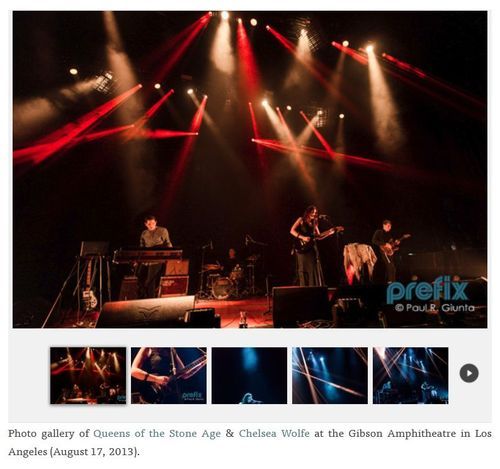
    imageimageimageClick above to see the photo gallery by Paul R. Guinta for Prefix Mag of last nights Sold Out show at the Gibson Amphitheater: Chelsea Wolfe supporting Queens of the Stone Age.

    And don’t miss Chelsea Wolfe playing FYF Fest this Sunday, August 25th at 4:45pm or on her headline tour with True Widow as support – SEE ALL CHELSEA WOLFE DATES HERE

  • Chelsea Wolfe Interview with Drunken Werewolf (UK)

    Chelsea Wolfe is about to return with her third album Pain is Beauty. It’s a record to which the words “haunting” and “beautiful” do no justice, drenched in a thick, looming atmosphere that doesn’t let up from start to finish.

    Since the release of her debut album The Grime and the Glow Wolfe has become well known for her charged, almost frightening take on alternative music. Pain is Beauty steps away from Apokalypsis in some ways, but it doesn’t let up on the Los Angeles based musician’s best asset: her penchant for layered noise build out of her ribcage.

    Ahead of the release of Pain is Beauty and our review of it, DrunkenWerewolf’s Tiffany Daniels speaks to Chelsea about recording with her band mate Ben Chisholm, carving something new out of her career and playing live with Queens of the Stone Age.

    Hello Chelsea, I hope you’re well! What have you been up to lately and how is album prep coming along?

    The album is finished, turned in and getting printed. Lately me and the band have been figuring out how to play these songs live, as it sometimes happens that way… Some songs you play live for a while and then record, some songs you write, record and then have to re-learn for the live set. We’re dealing with that at the moment and trying to work out all the technical kinks along the way. I’ve also been working on film and videos – a short film with a few songs from the new album with director Mark Pellington and a music video shot in the desert for the song “Kings”.

    You’re about to release your third studio album Pain is Beauty. How does it compare to Apokalypsis and The Grime and the Glow, in your eyes?

    I sometimes don’t think my albums have anything to do with each other because my mental state is so different from one album to the next. The Grime and the Glow was me starting over as a musician, going back to demo-style recording on my 8-track, rebelling against over-produced sounds that I had fallen into when I first started making music. Apokalypsis was a recording that sort of encompassed my live band and I at the time. I would write songs and we would play them at shows and built this sort of energy and I wanted to capture that. That was recorded a long time ago, I think in 2010. Most of Pain is Beauty was recorded in 2012 and grew from a desire to finally release some electronic songs my band mate Ben Chisholm and I had been writing for a few years and also to bring forth some more emotional songs I had inside.

    You seem to be a musician who’s very conscious of developing your sound rather than relying on what you know. Would you say that’s fair?

    Well, I just don’t like to feel confined to any one sound, genre or style of music. I’ve always been that way and in the past have referred to my music as bipolar or multiple personality because on one album I’ll have an acoustic track, an electronic track, a really gritty sound, a clean sound, etc., but for me I think I bring the songs together with mood and concept. I like to try new things and I like to learn new things, in music and in life.

    How did you approach the studio, this time around?

    I had the songs recorded in demo version, with most of the parts written. We worked with a great engineer Lars Stalfors at a studio in LA to capture a bigger sound that we could do at the home studio and also to gain some outside insight at times. Then we mixed the album for a good while with Chris Common. For me, mixing is the most important part because you have to remember all the elements and moments that were recorded and bring them together in the right way. I can always see it all in my head but I have to be very conscious and organized so I don’t forget anything.

    Was there an aspect of your time in the studio that you consciously wanted to change?

    Well I don’t like time limits so I don’t like the pressure of having a strict deadline. Music often works out of time or in slow motion for me so it’s really best if I can take my time to develop everything fully. In the future I’d like to build a better home studio so we can do things on that sort of schedule. I was lucky this time around though to have Chris Common who was very patient with me during the long mixing period.

    You worked closely with your bandmate Ben Chisholm on Pain is Beauty. What has he brought to the table?

    This project started as and will always essentially be a solo project at heart, but I also have really great bandmates who add so much to the recordings and live experience: Dylan Fujioka (drums), Kevin Dockter (guitars), Ben Chisholm (synths/bass/programming/piano). Ben came along at a time about 3 years ago when I really wanted to add an electronic element to my live band and I didn’t realize then what a great writing partner he’d become. We started writing electronic songs together with the original intent of doing a side project but then we got busy with the Chelsea Wolfe project and as I mentioned, eventually decided to incorporate some of those songs into the album and set. Ben has a great sense of editing. For example, he can take a simple short recording of a voice or violin and within a half hour have it cut up, layered and completely transformed into something totally new and magical. He also created a lot of beats for this new album using only samples of sounds from life around us – like steam and an industrial elevator. And he is a wonderful piano player! Someday we hope to produce other projects together.

    Do you find it hard to collaborate objectively with a person that you work with regularly, or do the benefits out way the negatives?

    It’s always going to be objective for me, so there’s always going to be some push and pull but we both approach music as our work and take it seriously so we’re willing to put in the time and emotion and energy it takes.

    What were your main influences and motivators for writing Pain is Beauty?

    Very elemental things like natural disasters, ancestry, the intensity of nature, tormented love. Connection to land and the possibility that the customs and mythology of our ancestors still remains within us through the bloodline. The way humans affect nature and the way that nature can overpower us in a second. The colors of nature. Loss of love in a natural disaster.

    The title Pain is Beauty fits in nicely with your goth-influenced sound, but why did you specifically choose it as the name for this album?

    It felt like a summary to all the different ideas and themes of the album. I like for a title to sum things up but to also be open to interpretation. For me it sometimes represents a healing process. The new growth that happens in the forest after a fire. The same way in our lives – we go through the fire, we overcome, we grow stronger, wiser, and that to me is beautiful.

    You’re about to embark on a huge world tour this autumn. Do you prefer life on the road to life in the studio?

     I love recording, even though it’s a tedious process. I think listening to a recording is somehow more intimate than being in a room full of people at a live show, but I also have come to appreciate playing live and seeing other bands live.. I understand it more. It’s taken me a long time to feel even remotely comfortable on stage in front of people, but at times the energy is so powerful, of the space, from the audience, that it all makes sense and it’s so special. I look forward to these tours because I’m excited to play the new songs and introduce a new album to the world, and we also get to tour with some bands I really love Russian Circles in Europe and True Widow in the US. I also look forward to tour because it’s a vacation from my spider-ridden home in Los Angeles. I live in a very old house and as soon as I start spending too much time there it begins to attack me! I have so many spider bites right now because I’ve been back for the summer. Los Angeles is not really my home, I just work there. I’ll return to Northern California when I can.

    What can the world expect from Chelsea Wolfe in the not too distant future?

    We’re opening for Queens of the Stone Age on Saturday – one of my favorite bands so that will be a treat. After that we play a festival in Los Angeles and then hit the road for the US tour. I’m already writing new songs in the meantime. Like I said, music never happens in order or in time. I’m writing and thinking about the next album even though I’m in the throes of the current one. I also just spent some time in Seattle recording some more collaborative songs with one of my favorites, King Dude. We released a split 7” earlier this year and will likely have another one in 2014.

    CHELSEA WOLFE IS ON TOUR NOW SEE ALL TOUR DATES HERE