


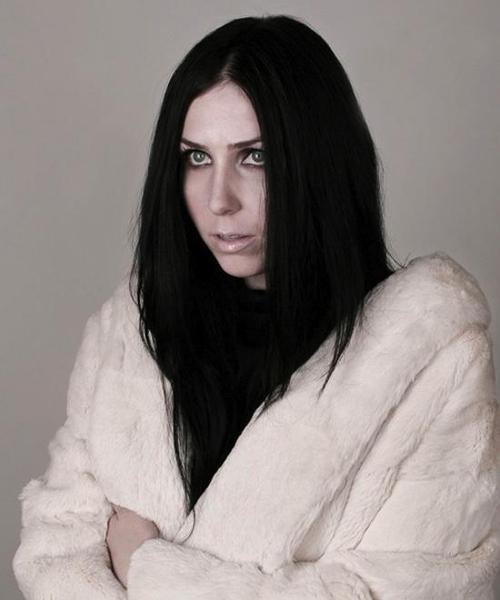
The photographs available of American singer/songwriter Chelsea Wolfe are hugely varied, but all seem to obscure her in some way. They’re akin to peering through a window into an unlit room, her pale face inconspicuous behind mourning veils, half-hidden beneath snakelike tendrils of black hair, or just blurry portraits of an arcane figure. Her sound is equally as nebulous and difficult to define. It’s folk, but with the pathos and epodic slant of a troubled soul. It would seem that Wolfe dwells rather a lot on death.
Following her debut album The Grime & The Glow and 2011 follow-up Apokalypsis, a particularly excellent performance at Roadburn festival gathered her fans from across various styles of metal. Black metal in particular feels like an obvious reference point, though admittedly that’s more to do with its misty and chilly atmospheres than its walls of caustic distorton. Wolfe’s supernatural songs are redolent of isolated pine forests, half-light percolating through tree canopies, and the malodor of rotten petiole. They suggest that death is just as lonely as we feared – yet their ghostly traces hint towards the way that our selves endure through the memories of others around us.
To coincide with the release of her Latitudes session Prayer For The Unborn, the Quietus spoke with Wolfe about haunted keyboards, photography and yes, mortality.
Could you tell me about the concept of your recent Latitudes recording?
Chelsea Wolfe: I had this character of a housemate for a while who would camp out in the living room playing records for days. Nothing usually caught my ear, but one day I was walking through and heard Rudimentary Peni and it stopped me in my tracks – I listened and was so drawn to the energy behind that voice. The roommate told me about the band as they were one of his favorites – even his cat was named Blinky, after Nick Blinko. I couldn’t find a lot of their music online but I found lyrics and read all of them. I was haunted by Rudimentary Peni for days, weeks, until I finally was possessed fully one night and sat down to record five sort of covers of their songs, just based on the lyrics. They’re interpretations really, more than covers, since they don’t sound like the original songs and I hadn’t heard all of the songs I covered at the time.
I put those recordings on the internet for a while, and then when my UK/Europe tour was booked last spring, Southern Recordings in London asked if I wanted to come and do a session for a Latitudes release. I decided to re-work the Peni covers with my band and we recorded them with Harvey Birrell at Southern. I didn’t realise until that day that Harvey had actually recorded many of Rudimentary Peni’s albums! Strange fate. We had a really great time making this album – one of my favorite projects so far.
I really feel like your music works as a soundtrack to photograph by people like Nan Goldin and Diane Arbus – there seems to be something undefinable and ‘other’ about your sound. Do you have any visual representations you try to evoke with your music?
CW: Thank you – that’s a high compliment in my eyes. I have always adored the work of artists like Nan Goldin, who can take ordinary sadness and turn it into lasting beauty. I try to approach music as a slow-motion painting… something lush and cinematic, but grounded. I admire Werner Herzog and Lars von Trier for this quality to their films. Film and photography and painting and literature are the things I find most inspiring for my songs.
Your sound seems to be transiently slipping through genres, ghost-like and intangible – doom, drone, black metal, gothic, folk and dark ambient could all legitimately be used to describe it. It’s a prosaic question, but is it important to you that people interpret your music in a certain way?
CW: I’ve come to a point where I’m comfortable with and happy to have people interpret my music in their own way. I appreciate it when folks understand my music and relate to it and find it useful or helpful in their own realm. It’s an honour. I think a song can mean a million different things depending on the listener’s personal life experience. I do have a hard time sticking to one genre, and honestly I prefer it that way. I’d rather be free to experiment and make the kind of art I want to make than be easy to define.
Your personal aesthetic and artwork are incredibly expressive, specific and seem relevant to your work. Where do you derive your inspiration for these visual aspects?
CW: Again, it’s a lot of experimentation and following an idea. In my life I’ve ended up with some good friends who are also great photographers so I’ve been lucky to play around with them and see what works and what we can come up with. I get inspiration from designers, from films, from nature. For my live show I typically keep things minimal. I want it to be more about the energy of the music and the visuals in the person’s mind when they close their eyes.
Do you believe in the supernatural? Have you ever seen a ghost?
CW: I’ve only had one encounter with a “ghost” or spirit.. When I was a kid I had this keyboard piano that you could record songs into. It had spaces for three songs. On the first space I had recorded a simple piano pattern. I have never been very good at piano, nobody in my life was, it was just a simple repeated four-note pattern. On the second space I recorded a beat and some ocean sounds or something funny. The third space was open for a long time until I finally came home from school one day with an idea. I checked that third space to make sure I hadn’t forgotten about something I had recorded. I was surprised to hear the four-note pattern from the first track playing slowly, then dropping into a dark and beautiful piece based on those four notes, finally returning back to my pattern. It was far too lovely to be a glitch. I recorded it into my handheld recorder and eventually converted it into an mp3 so I still have it. Appropriately, at the time of this occurrence my backyard was basically a graveyard. We had a small yard which looked into the largest cemetery in my town. Overhearing funerals was a daily occurrence.
Your lyrics are arcane, insightful and ultimately very personal. What informs them?
CW: Since I was a kid, I knew that I understood sadness in a certain way, and that I could interpret that into words and songs. I was always drawn to brutal honesty in music, to stark reality and yet also beautiful, lush, idealism and even mysticism. Seeking out the truth and being very honest about it I suppose brings my music to a very personal place, but often my lyrics have nothing to do with my own life, they’re more about creating a world or telling a story.
You sometimes wear a mourning veil onstage or your face is obscured by your hair! Is there a certain element of exposure to playing live that you feel uncomfortable with?
CW: I haven’t worn the veil for a couple years now, but yes, there is definitely an aspect of live performance that I’m not comfortable with. I sometimes wish there were no cameras at concerts. I wish people could just be there with me without trying to capture it for others to see. When I see a camera pointed at my during a show I get distracted, so yeah, I usually try to make eye contact with people who are listening or cover my face with my hair so I can keep focused on the song.
The veil started out as an experiment in visuals; expressing a sense of mourning or funeral marches. But then I realised it really helped me separate myself from the fact that I was performing. It was a very child-like thing to do I suppose, like covering my face would make it so nobody could see me! But while I’ve always felt comfortable and natural as a singer and songwriter and person who records music, live performance is a different challenge. The reason it took me so many years to become a serious musician is because for a long I didn’t believe I could be someone who could be a performer, someone people looked to and listened to in that kind of setting. It’s still strange, but I accept it as part of my job and an extension of the recordings, so I do my best to lose myself in the songs and give all of myself to the audience.
Why do you push your voice through distortion on your recordings?
CW: I like the idea of a voice being pushed through machines and electricity. I’ve always loved white noise, and my favorite pedal to sing through is this really fucked up old digital reverb that has these long, drawn-out moments of unexplainable noise. It feels like a haunting. I sometimes experiment with clean vocals and also enjoy that feeling of in-the-same-room intimacy, but I often think of the voice as another instrument and so run it through pedals and loops, just like I would with an electric guitar.
A personal question – ‘Halfsleeper’ is one of my all time favourite songs, it makes me cry, and it also frightens me. When I’m by myself sometimes I have to skip it, it calls up a feeling like when I was small and the wind in the trees used to scare me. What’s it about?
CW: Death is a subject that many of my songs explore, probably because I haven’t experienced it much myself and so I became obsessed with it. I was introduced to Death as a character in Ingmar Bergman’s The Seventh Seal and reading Sylvia Plath poems. The line “death is the dress she wears” is a line that always stood out to me. ‘Halfsleeper’ is about dying in a car accident with a loved one. I wrote it after seeing some particularly brutal and colorful roadkill by the freeway on a bright day. So much of our lives consists of driving and sleeping. When you die everything petty becomes unimportant, and love is what remains.


